When most people think of massage, they might picture lying quietly while someone works with oil and steady hands. But traditional Thai massage can feel quite different from most massage styles people are used to. Instead of staying still on a table, you are gently moved through a sequence that combines stretching, pressure, and slow, rhythmic touch.
Rather than relying only on pressure to release tension, this style supports relaxation in a more active way. Every movement has a purpose, every pause gives you a chance to reconnect with how your body feels. It is about presence as much as technique.
The Roots of the Practice
Traditional Thai massage comes from a long heritage of movement-based bodywork rooted in Thai culture. While the philosophy behind it is complex, the experience itself feels simple and quiet. It is shaped by three key ideas: breath, pace, and contact.
- Breath helps set the rhythm. Both the person receiving and the person giving the massage take their time.
- Pace is slow and steady. Rather than rushing through, each part builds on the last.
- Touch is intentional, meaning the pressure is applied with care using different parts of the body, not just the hands.
This method works with the body’s natural energy channels. You do not have to understand the concept of energy lines to benefit from it. Most people notice they feel more connected and grounded by the end of a session, even without knowing how or why.
At La-Moon Thai Massage in Caulfield North, VIC, we offer authentic traditional Thai massage provided by experienced therapists. Each session is adapted to the individual’s needs, combining centuries-old techniques with a serene environment to promote deep relaxation.
What to Expect From Your Session
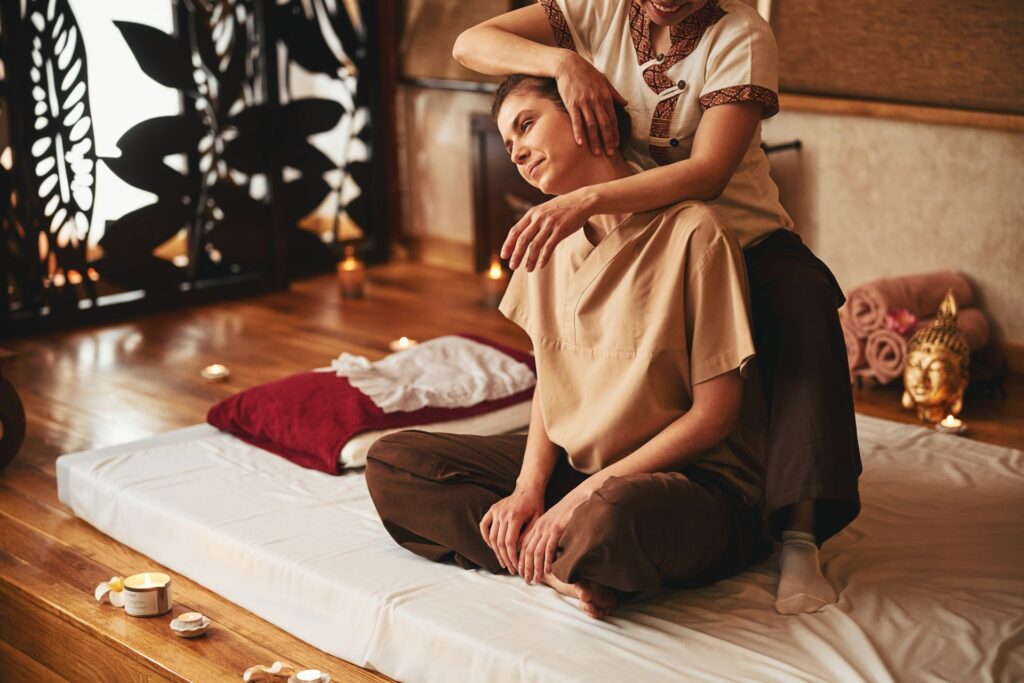
From the moment you enter the massage space, things might feel a bit different from other treatments you have had. The setting usually involves a padded mat on the floor, soft lighting and a quiet, calm energy.
- You keep your clothes on during the session, which is why wearing something loose and stretchy helps.
- There is less focus on oils or skin contact and more on movement. You are guided through gentle postures that resemble relaxed stretches rather than fixed positions.
- The session may begin with light rocking or breath awareness, easing into a sequence that flows naturally from one shape into the next.
We do not rush. The aim is to move with you, not faster than you, so the benefits build over time, not all at once.
Movements, Pressure, and Flow
One of the things that makes this style stand out is how we use different parts of our body to apply pressure in a balanced way. Rather than pressing down firmly with thumbs, we often lean in using palms, forearms or even feet, depending on what feels best in that moment.
- Compression helps settle the muscles without bruising them.
- Gentle rocking may soothe areas that feel stuck or worn out.
- Assisted stretching invites space into joints and soft tissue without forcing anything.
That combination of motion and stillness leads to a sense of openness many are not used to from other massage styles. Compared to deep tissue or oil-based treatments, this work connects breath and shape in a way that follows how your body likes to move, not just how it looks on a diagram.
Late Summer and Your Body’s Need to Slow Down
By early March, the warmth of summer begins to fade and the energy of long days and late nights starts to wane. It is a time where we often carry remnants of that go-go-go mindset, even if physically we feel like we are running out of steam.
- The long heat can leave the body buzzing, but also a little frayed and tired underneath.
- Some people find their sleep patterns feel off, or energy comes in surges that do not last.
- Traditional Thai massage meets that exact rhythm with calm and softness, not to fix you, but to shift your pace.
Before autumn arrives fully, this style of massage can help ease that in-between season. It taps into rest without knocking you into stillness, which often feels better when you are trying to find your balance again.
Learning to Respond Instead of Push
Many of us are used to powering through discomfort, ignoring the signs until we cannot anymore. That is part of why it can feel unfamiliar when we slow down on purpose.
- Traditional Thai massage helps retrain the body to respond to what it is actually feeling rather than ignore it.
- Rather than bracing or stiffening up, you are guided to soften and release in ways that feel easy on the nervous system.
- With time, that helps build a habit of listening gently instead of pushing harder.
This is not about deepening the stretch or bearing more weight. It is about understanding what the body needs at that moment and honouring that with movement that offers relief, not effort.
Letting the Body Catch Its Breath
More than anything, this form of massage invites us to pause. It is not a place for goals or fixing. It is a chance to spend an hour in your own body without needing to achieve or improve anything.
Traditional Thai massage works slowly so the body has the space to soften. It adapts in the moment, listening instead of pushing. That change of pace is often what supports the shift, not just in muscle tightness, but in how we feel as a whole.
As March moves us from summer into autumn, slowing down becomes easier to welcome. The quiet rhythm of traditional Thai massage does not ask much. It simply offers steady support in a time where most of us are ready to breathe and reset.
At La-Moon Thai Massage, we see how steady, mindful touch can guide the body into a much-needed pause, especially during seasonal changes. Curious about support that feels less like effort and more like relief? Our space in Caulfield North, VIC, is shaped around presence and ease rather than pressure or intensity. Discover how a traditional Thai massage encourages your natural rhythm and gentle awareness, and give us a call to book a time that gives your body room to slow down.